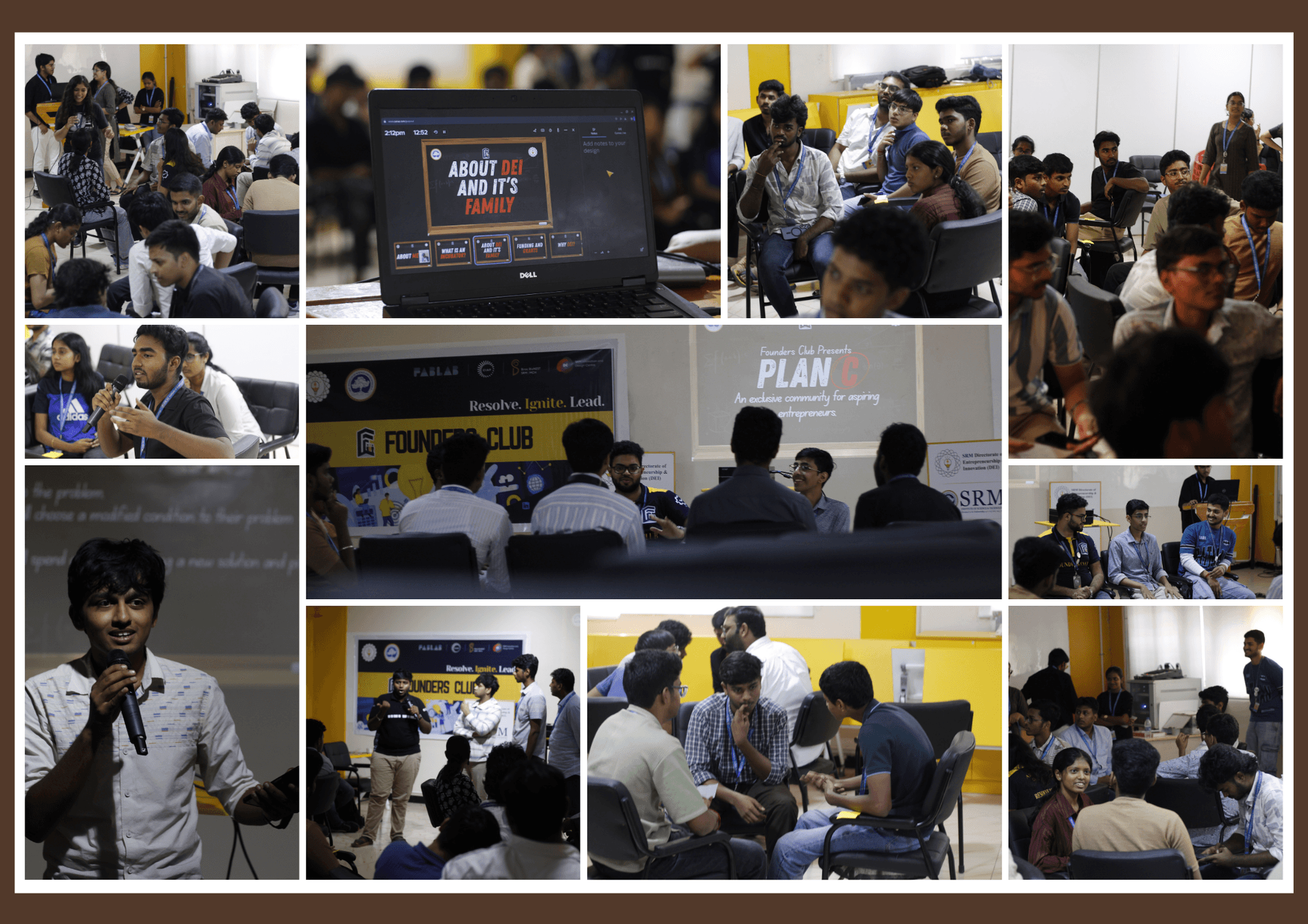
Plan-C: Turning Ideas into Impact — A Founders Club Initiative
Plan-C by the Founders Club showcased innovation and teamwork under Presidents Rohan Bandari and Pratyaksh Dwivedi, coordinated by Lehan Vats.

Introduction: Enabling Young Innovators at Founders Club
At Founders Club, we have always believed that ideas matter only when people are willing to act on them. Over time, the club has focused on creating spaces where students can speak openly, try things out, and learn from real experiences rather than just theory.
With this thought, Plan-C was conducted on 11 October 2025, starting at 9:00 AM, at the DEI Inspiration Studio (BEL 506). The event was supported by the Directorate of Entrepreneurship and Innovation and was planned as a practical learning session for students who were curious about startups, business, and innovation.
Around 70 students showed interest and registered, while 35 participants attended the event and stayed actively involved through the sessions. Most of them were from the first and second years, and for many, this was their first exposure to an entrepreneurial discussion in a real setting.
Planning and Leadership Behind Plan-C
The overall direction of Plan-C came from the efforts of the Founders Club Presidents, Rohan Bandari and Pratyaksh Dwivedi. Their involvement helped shape the purpose of the event and ensured it stayed focused on learning rather than competition.
The coordination and flow of the event were managed by Lehan Vats, whose planning helped keep things organized throughout the day. We also received continuous guidance from Ishan Roy, the Club Advisory Head, whose feedback and mentorship helped refine the structure of the sessions.
Structure of the Event and Participant Engagement
The event began with a simple introduction and interaction session. Participants introduced themselves and spoke briefly about their interests, ideas, or the areas they wanted to explore. This helped break the initial hesitation and made it easier for students to talk and connect with each other.
As the event progressed, the focus shifted toward understanding entrepreneurship in practice. Topics such as early startup challenges, basic legal documentation, and real-world limitations were discussed. Participants were later divided into randomly formed groups and given a problem-solving activity. Each group worked within given constraints and shared their ideas with the rest of the participants.
Core Learning Sessions and Speaker Insights
Understanding the Art of Pitching — Session by Pratyaksh Dwivedi
One of the key sessions of the event was “How to Pitch an Idea”, led by Pratyaksh Dwivedi. The session focused on how to present ideas clearly and confidently, especially in front of an audience.
Students learned how to explain a problem, build a solution around it, and communicate their thoughts in a structured way. The session was interactive and encouraged participants to think about how they present their ideas, not just what the idea is.
Insights from Experience — Talk by Sarathi R Chandran
Another important part of Plan-C was the session by Sarathi R Chandran, who spoke about his journey as an entrepreneur. He shared the challenges he faced, the mistakes he made, and the lessons he learned along the way.
His talk helped students understand that setbacks are a normal part of the process. He emphasized consistency, learning from experience, and staying open to change while building something from scratch.
Documenting the Experience: Visual Coverage of Plan-C
To capture the event, a vlog was created that documented both the sessions and the moments in between. Joshua K Biju handled the videography, capturing the atmosphere and interactions throughout the day. Bhavika Gupta spoke with participants and speakers, bringing out their thoughts and reflections through short interviews.
The final video reflected the learning-focused and collaborative nature of the event.
Collaborative Efforts and Operational Support
The event was supported by the combined efforts of the Operations and Marketing teams. From handling logistics to promoting the event across classrooms and digital platforms, the teams worked together to ensure the event ran smoothly.
Despite limited preparation time, the sessions progressed without major issues, thanks to volunteer coordination and teamwork.
Observations, Outcomes, and Key Takeaways
Plan-C was useful for students at different stages. Those who already had ideas received feedback and new perspectives, while others gained exposure to how collaboration and problem-solving work in real situations.
There were also areas to improve. Some participants joined late and missed initial information, showing the need for clearer communication at the start. Participation from first-year students was lower than expected, mainly due to timetable overlaps.
Future Direction and Continued Initiatives
Plan-C gave students a clearer picture of what entrepreneurship involves and how ideas move toward execution. It also introduced participants to concepts such as pre-incubation and incubation, helping them understand possible next steps.
The event reinforced Founders Club’s focus on creating meaningful learning experiences for students. Moving forward, the club aims to organize more such initiatives that support curiosity, collaboration, and practical learning.